


World Nomad Games 2026
Updated: Dec 5, 2025
The VI World Nomad Games will be held in Kyrgyzstan from August 31 to September 6, 2026. The opening ceremony will take place in Bishkek, and the closing ceremony will take place on the shores of Lake Issyk-Kul.
Sports at the World Nomadic Games
Currently, the world has a huge number of sports events, for example, the Olympic Games, Asian Games, even Asian indoor games, Universiades, Spartakiad, in addition, continental and world championships in sports are held all over the world. They are united by the format of the event in the form of "poor sport" and aimed exclusively at fans and connoisseurs of certain sports. Approximately the same format competitions were held at the First and Second World Nomadic Games: sport was the first to be put in the leading place from the three directions (sport, culture, science).
The WNG introduces a completely different format: the first place is the culture of nomads. After all, culture is a broad concept that includes traditions, customs, everyday life, as well as sports in the form of folk games and amusements. Sports competitions for the WNG will be held in an ethnocultural form with observance of all the rituals and traditions that accompanied the competitions in these sports since ancient times. Competitions will also be held with theatrical performances and musical accompaniment of folklore groups of countries of the world, and athletes participate in them only in the national dress of their countries.

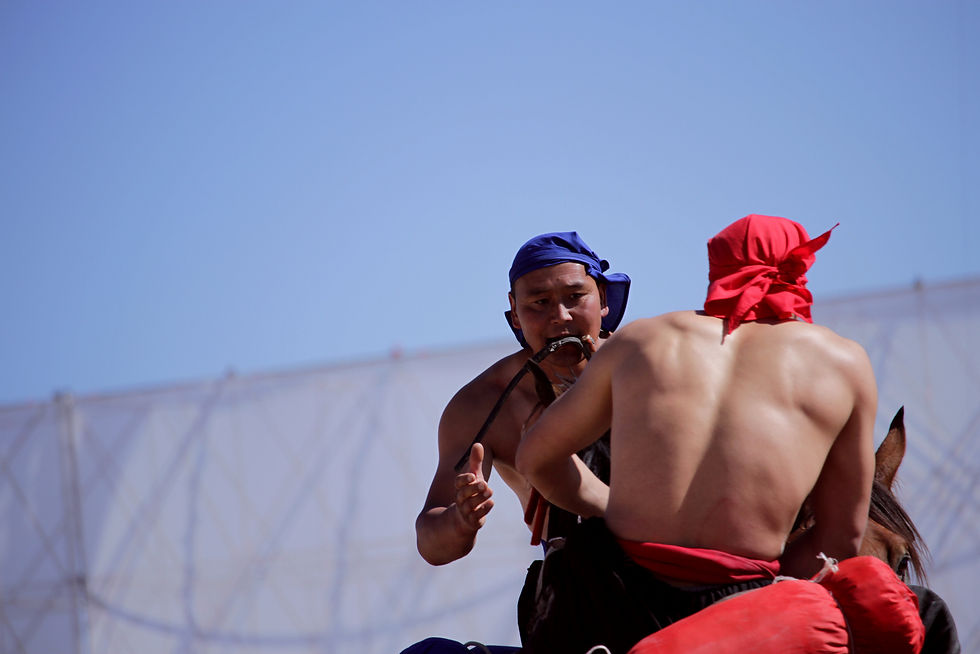
Er Enesh - traditional Kyrgyz horseback wrestling. This discipline was born out of military needs and served military purposes. The key to victory in er enish is the skill and strength of both the rider and their horse. A horse for er enish must be heavy and strong, stable, maneuverable, and calm, with impeccable obedience to the rider and endurance.
Currently, er enish competitions are held on a flat, circular area. Two wrestlers compete, stripped to the waist. They must wear a "sash" (belt), a scarf, trousers made of sturdy material, boots, and a whip in their hand. At the start of the bout, the wrestlers, mounted on horseback, ride to the center of the circle at the referee's command. On command, the bout begins. To win, a wrestler must pull their opponent off their horse until any part of their body touches the ground.
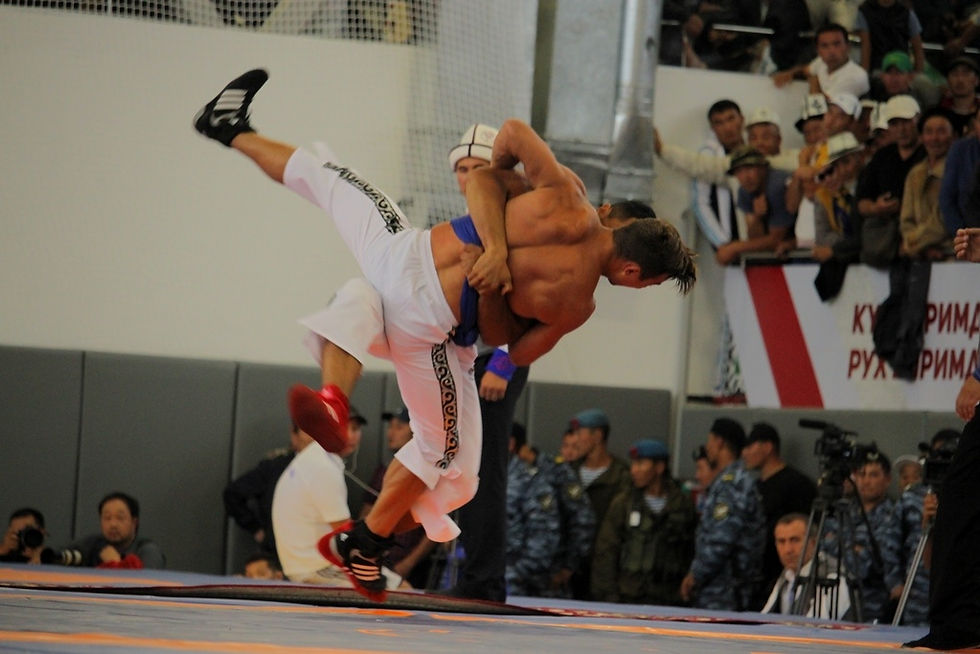
Alysh is a traditional Kyrgyz belt wrestling sport, which features a fixed belt grip. Alysh is divided into freestyle (where technical kicks are allowed) and classical style (where technical kicks are prohibited).
The history of Alysh belt wrestling goes back centuries. This style of wrestling is one of the ancient sports of the Kyrgyz people.
Wrestlers wear special blue and green T-shirts, white pants, and a red belt. In the starting position, the wrestler's head rests on the opponent's shoulder, watching the opponent's leg movements from under their arms.
Wrestlers grasp the opponent's belt by bending forward at the waist, passing their right arm over the opponent's right arm, and their left arm over the opponent's right arm. Wrestling takes place in a standing position. Each wrestler's goal is to attempt to bring the opponent down without releasing their belt.
Kök börü is an ancient equestrian sport popular among the Kyrgyz and other Asian peoples. The game is popularly known as "ulak tartysh" (goat tug-of-war or goat dragging). Kök börü is a combination of horse racing and gameplay. Riders compete for the goat's carcass—they must not only seize it but also hold it, and then throw it into the opposing team's "taikazan" (goal). The game is also popular in Kazakhstan, parts of Russia (Altai, Bashkortostan, and others), Uzbekistan, Tajikistan,
Afghanistan, Pakistan, China, Turkey, and Mongolia.
"Kök börü" literally means "gray wolf." Long ago, there was a common form of wolf hunting where a group of horsemen would chase a wolf, catch it, and kill it with blows to the head with clubs. This ancient method of wolf hunting is also interesting because, after one of the horsemen caught and killed the wolf, he would place the carcass across his saddle, and the other horsemen would try to take it from him. Thus, while riding toward their village, they played kök börü.
According to the rules of kök börü, a team consists of 12 horsemen and 12 horses, but only four players from each team can play at any one time. The game lasts three periods of twenty minutes each. The goal of the game is to seize the goat carcass and throw it into the opponent's taikazan as many times as possible.

Endurance racing is an equestrian discipline in which victory is determined by the fastest time a rider completes a distance while maintaining normal physiological parameters.
Endurance racing is aimed at developing the horse's endurance over distances and the rider's ability to accurately assess the horse's physical capabilities over a distance. Endurance competitions are held in natural conditions, on a specially marked course, with timed completion times and veterinary inspections of the horse throughout the competition.
Endurance racing is believed to have originated in Arabia, where nomadic Bedouins, having discovered that horses could move faster than camels in the desert, began testing Arabian horses in races.
Traditional horse racing is one of the most exciting and ancient sports of the Kyrgyz people. Races were held at various folk festivals, and fast and hardy horses capable of enduring long distances were selected for them. The winner received jewelry or livestock as a reward. In addition to races in which horses trot in a normal style, races were also held for
pacers. Ambling (zhorgo) is a two-step race, in which the animal's legs rise and fall to the ground in pairs. During this run, the horse seems to roll from one side to the other, and only two hoofbeats are heard. A horse's ability to amble is highly prized, as not every horse is capable of it.
Horse racing is divided into types depending on the distance of the race, the running style, and the age of the horse:
1. At chabysh – a long-distance race for horses of all ages, covering a distance of 22 km.
2. Kunan Chabysh – a race for two-year-old horses over a distance of 11 km.
3. Zhorgo Salysh – a race for pacers of all ages over a distance of 11 km.
4. Byshty Zhorgo – a race for three-year-old pacers over a distance of 6 km.
Güreş is one of the traditional forms of Turkish güreş wrestling. It involves grappling with arbitrary holds on the opponent's clothing and body. The technique is rich in various kicks, throws, and grabs of the opponent's belt and jacket, or one leg and belt. The matches are invariably accompanied by musical instruments: the drum (davul) and the wind instrument (zurna).
In the early days of aba güreş, opponents entered the bout wearing short capes with slits for the arms or sheepskin jackets (aba), from which the sport derives its name. Historically, the Turks were always prepared for war, even in times of peace. Therefore, wrestling served not only as a means of physical education but also as an important element of military training for young men and women.


Comments